Hello everyone, this is Sushi Hatake!
In my previous article, I shared my first impressions of Vung Tau, Vietnam. This time, let’s get into what I was really here for — the fish.
Vung Tau is a coastal town, so naturally, seafood should be abundant. But here’s the thing: “having lots of fish” and “having fish you can use for sushi” are two completely different things.
In this article, I’ll share what I honestly felt after visiting the local market at dawn and eating at a sushi restaurant in town — all through the eyes of a sushi chef and former organic farmer.
Sneaking into the Market at 5:40 AM
During my stay, I woke up at 5:40 AM and headed to the local market. I’d checked Google Maps beforehand, but when I arrived, the place was still nearly empty. A huge market, yet barely any fish in sight.
After wandering around for a while, I finally found the fish section — but what actually caught my eye first was the vegetable area. The vegetables were incredible (more on that later).
Fish at the Market: Plenty of Variety, But…
Let me walk you through the fish I spotted, from a sushi chef’s perspective.
The first thing that stood out was hairtail fish (tachiuo). There was a ton of it. Shrimp was abundant too — a testament to Vietnam’s rich seas.
Bonito (katsuo) was everywhere. In the video, I couldn’t help repeating, “They’ve got bonito, man — so much bonito.” Seeing familiar fish from Japanese sushi counters just sitting there in a Vietnamese market is pretty exciting.
I also spotted what looked like Spanish mackerel (sawara), pomfret (managatsuo) — though a different variety from the Japanese type — golden threadfin bream (itoyori-dai), which is apparently caught in large numbers locally, something that looked like sea bass (suzuki), and possibly even amberjack (kanpachi). “I can work with this!” — I couldn’t help getting excited.
Shellfish and cuttlefish were well represented too, including what looked like ark shell (akagai) and cuttlefish (kouika). I saw serious potential in the shrimp and shellfish especially.
But could I actually use any of this for sushi? That’s where the problems start.
Three Issues That Concerned Me as a Sushi Chef
1. No Proper Icing
This was the biggest problem. The fish at the market basically had no ice treatment at all. From a freshness management standpoint, using these directly as sushi toppings would be extremely difficult.
In Japan, temperature management with ice starts the moment fish are pulled from the water — it’s standard practice. Without that single step of keeping fish cold, quality drops dramatically.
2. Everything Was “Nojime” (Not Properly Killed)
Every fish I saw at the market was nojime — meaning the fish had died naturally. In contrast, fish used at Japanese sushi restaurants are processed using methods like ikejime (spiking) or shinkeijime (nerve destruction) to preserve maximum freshness.
Nojime fish tend to lose their firmness quickly, and the flavor deteriorates faster. Improving this is essential if you want to use local fish for sushi.
3. Direct Negotiation with Fishermen Is a Must
Simply buying fish as-is from the market won’t get you sushi-grade quality. You’d need to connect directly with fishermen and negotiate how they kill and preserve the fish.
This actually reminds me of my farming days. Back then, chefs would visit farms directly, saying things like, “I want this kind of vegetable” or “Can you harvest at this specific timing?” It’s the same with fish — you have to work with the source to shape “how it’s caught and how it’s handled” from the very beginning.
Visiting a Sushi Restaurant in Vung Tau
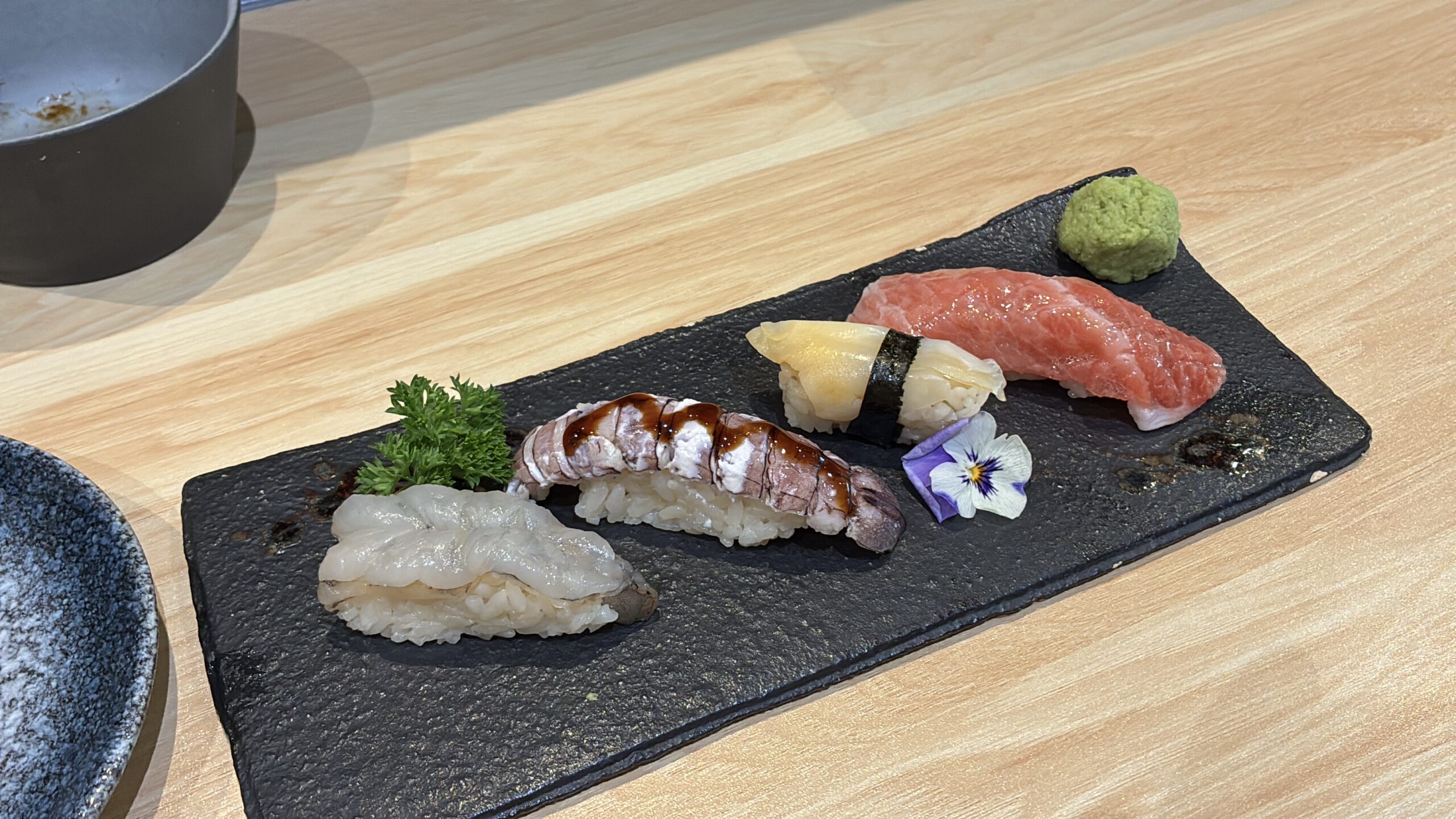
I didn’t just visit the market — I also ate at an actual sushi restaurant in Vung Tau. Located near a Buddha statue, the place offered lunch sets for about 900 yen (roughly $6 USD). A bit cheaper than Japan.
The nigiri selection included surf clam (hokkigai), a white fish that was probably grouper, what seemed like yellowfin tuna, shrimp of an unknown variety, mantis shrimp, whelk, bluefin tuna belly (otoro!), sea urchin, salmon roe, and minced tuna (negitoro).
Honestly? Some of the toppings made me a little nervous. The color of the shrimp concerned me, and there were textures I’d never experienced before. They had otoro and sea urchin on the menu, but given the price point, I couldn’t help wondering about the sourcing.
That said, the fact that a restaurant in Vietnam is assembling this range of toppings and serving nigiri sushi is impressive in itself. It really drove home how far sushi culture has spread.
A Former Farmer Gets Fired Up About Market Vegetables
This is supposed to be an article about fish, but please let me say this: the vegetables at the market were absolutely incredible.
They had kohlrabi. They had misaki cabbage (a pointed cabbage variety). They even had stick senor (stem broccoli)! These are vegetables that can be hard to find even in Japanese supermarkets, and here they were, just sitting in a Vietnamese market like it was no big deal.
As someone who spent six and a half years as an organic farmer in Gifu, this was a thrilling sight. “I’m honestly not great at cooking, but seeing these vegetables makes me want to cook” — that’s how good they looked.
One thing to note: leafy vegetables need cool weather to thrive, so whether this quality holds up during Vietnam’s hot season is a question mark. Regardless, as a former farmer, I see enormous potential in Vung Tau’s vegetable scene.
The Big Question: Can You Make Sushi in Vung Tau?
My conclusion: not right away, but the potential is definitely there.
The variety of fish is impressive — bonito, hairtail, pomfret, golden threadfin bream, shrimp, shellfish, cuttlefish. The raw ingredients exist. But the infrastructure that Japan takes for granted — proper freshness management and fish processing methods — simply isn’t in place yet.
If you wanted to serve authentic sushi in Vung Tau, you’d need to connect directly with fishermen and teach them everything from killing techniques to proper icing — from the ground up. In farming terms, it’s like building a production region from scratch. It takes time, but it’s the kind of challenge that would be deeply rewarding.
I’m planning to stay in Vung Tau for a full month in March 2026. This time, I want to dig deeper — exploring the fishing ports and building connections with local fishermen.
I filmed plenty of footage at the market and the sushi restaurant. Check out the video for the full experience!
Sushi Hatake offers catering sushi services mainly in the Tokyo area, delivering authentic Edomae sushi with seasonal ingredients to your doorstep. English support is available for international guests. Feel free to reach out anytime.