Hello everyone, this is Sushi Hatake!
Today, I’d like to dive a little deeper into the topic of shari (sushi rice).
In my previous articles, I wrote about the problem of rice sticking to your hands:
- Solving a Sushi Chef’s Struggle: My Battle with Sticky Sushi Rice
- Summer is the Enemy of Sushi Chefs!?
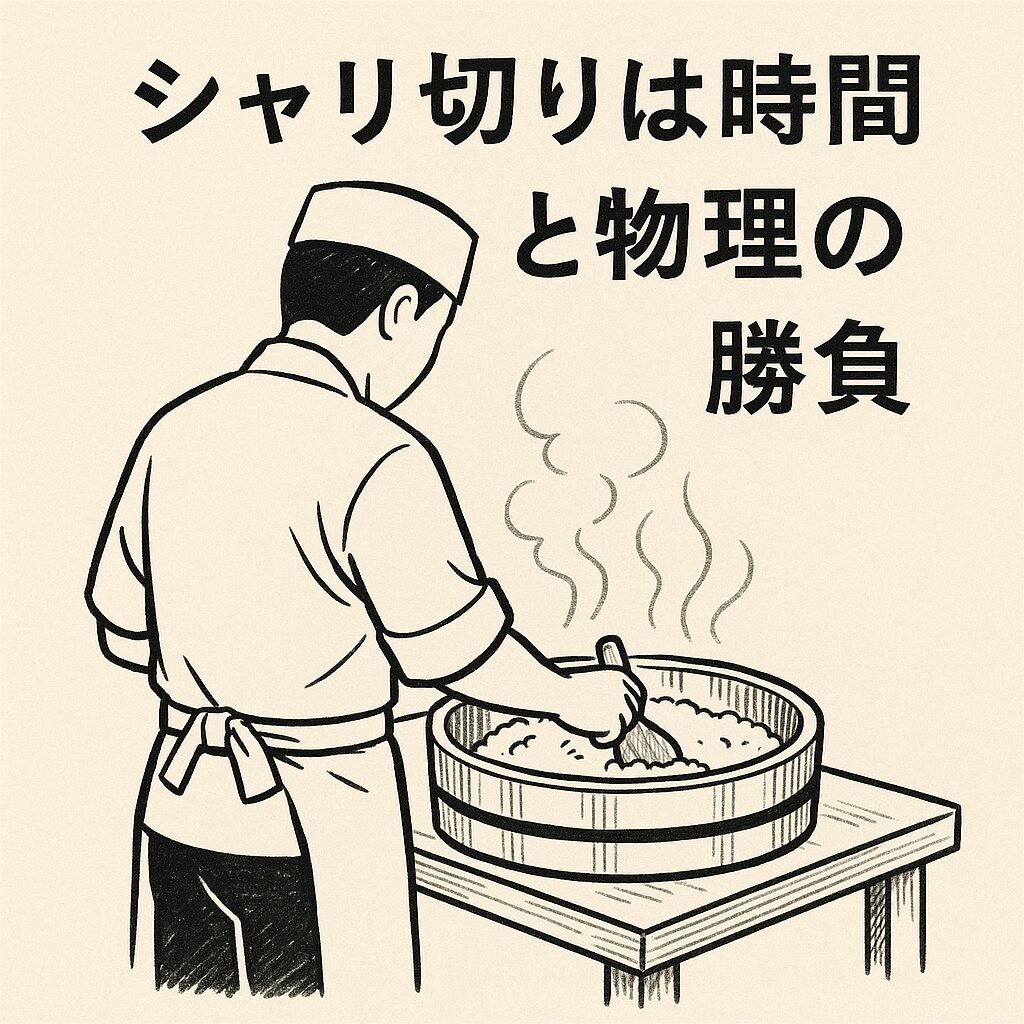
This time, I want to take it one step further and explore shari-kiri itself—the process of mixing vinegar into freshly cooked rice.
The Common Wisdom: “Fan Your Sushi Rice”
In sushi kitchens, there’s a saying that’s been passed down for generations:
“Fan your shari with an uchiwa (Japanese fan).”
“You have to cool down the rice.”
At many sushi restaurants, you’ll see chefs fanning the rice right after mixing in the vinegar. Ask them why, and they’ll usually say:
“If you don’t cool it down, it gets sticky.”
But is that really true?
At our restaurant (Sushikawa), we don’t fan our shari. After shari-kiri is done, we put the rice straight into a high-humidity shari warmer filled with steam.
And yet, the rice doesn’t stick to our hands.
Is this just an unusual method? Or is the purpose fundamentally different?
What Science Actually Tells Us
Food science has given us some understanding of why cooked rice sticks to your hands.
During cooking, the starch in rice undergoes gelatinization, making the surface of each grain sticky. When this gelatinized starch (especially amylopectin) is exposed, it tends to stick to your hands and to other grains.
This much is where experience and science align.
Does Sushi Vinegar “Reduce” Stickiness?
In the sushi world, people often say that “sushi vinegar coats the rice.”
Intuitively, this makes sense. But scientifically, we need to be careful here.
Recent research has actually shown that rice cooked with acetic acid becomes MORE sticky and softer—not less.
So we can’t simply say:
“Vinegar reduces starch stickiness, which is why shari doesn’t stick to your hands.”
To be honest, the exact mechanism of how sushi vinegar affects “hand-stickiness” hasn’t been fully explained by science yet.
So Why Doesn’t Rice Stick to a Sushi Chef’s Hands?
One factor that’s often overlooked is tezu—the vinegared water that sushi chefs constantly dip their hands in.
During nigiri-making, a chef’s hands are always moistened with tezu. Why this works isn’t completely understood, but some possible reasons include:
- When vinegar evaporates, it draws heat away from the hands, cooling them down
- A thin layer of moisture on the hands prevents direct contact between starch and skin
In other words, whether shari sticks to your hands depends on a combination of:
- The properties of the rice itself
- How evenly the shari-kiri was done
- Tezu as an “interface” between rice and hands
This understanding matches what we experience in the kitchen.
Why Shari-Kiri Still Matters
So why does well-executed shari-kiri result in rice that doesn’t stick to your hands?
From here on, this isn’t scientifically proven—it’s what we’ve observed repeatedly in practice.
When shari-kiri is done quickly and evenly:
- The rice grains separate properly
- The sushi vinegar distributes evenly throughout
- There’s less uneven moisture
The result is shari that doesn’t stick to your hands.
I can’t explain the molecular-level reasons for this. But we can clearly see the difference in results when shari-kiri is done quickly and without unevenness.
My boss puts it this way:
“Shari-kiri is a race against time—how quickly can you get the vinegar distributed throughout the rice?”
This isn’t scientific proof, but it’s a fact we’ve confirmed over and over in practice.
The Real Purpose of Fanning
After researching various sources and literature, I discovered something:
The purpose of fanning isn’t actually to cool the rice.
The real purpose is to evaporate the excess moisture that appears right after adding sushi vinegar.
Cooling is just a side effect.
If your shari-kiri is incomplete and moisture or unevenness remains, fanning makes a lot of sense. It helps even things out and makes failure less likely.
Why We Choose Not to Fan
At our restaurant, we prioritize finishing shari-kiri as quickly as possible.
By the time we’re done, there’s almost no excess moisture left to evaporate. That’s why we don’t fan.
Not fanning doesn’t mean we don’t care about temperature. The shari is kept in a high-humidity warmer filled with steam, maintaining its state without change.
What matters isn’t a specific temperature number—it’s:
“Keeping the completed shari from changing.”
Conclusion: What We Know and What We Don’t
Here’s what I wanted to share in this article:
What science tells us:
- Gelatinized starch is the cause of shari’s stickiness
- The main purpose of fanning is to remove moisture, not to cool
What we’ve confirmed through experience:
- Fast, even shari-kiri results in rice that doesn’t stick to your hands
- The quality of shari-kiri affects all subsequent steps
What science hasn’t fully explained yet:
- The exact mechanism of how sushi vinegar affects hand-stickiness
- Why evenness in shari-kiri affects stickiness at the molecular level
Sushi technique includes parts that science can explain and parts it can’t yet.
That’s exactly why the practical wisdom of “we don’t know why, but this works”—passed down through generations—remains so valuable.
The reason for fanning sushi rice isn’t to cool it down.
It’s really about removing excess moisture.
If your shari doesn’t have excess moisture to begin with, there’s no need to fan.
Shari-kiri is a race against time and physics.
Get this right, and everything else becomes simpler.
I provide sushi catering services throughout Tokyo. Experience authentic Edomae sushi, crafted with attention to every detail—including the shari.